
A Sales to Operations Handoff Checklist for New Customers
Give delivery the context it needs before kickoff. Use six handoff fields to pass on customer scope, commitments, open questions and ownership.

The customer has signed. Then the delivery team asks them to explain the whole project again. The customer repeats the deadline, points out a requirement they discussed during the sales calls and wonders whether anyone passed the notes on.
That is a difficult start to a new relationship. A signed deal should give the next team enough context to begin without sending the customer back to the beginning.
A sales to operations handoff checklist helps the teams agree what must travel with the deal. It should cover what the customer bought, what they were promised and who takes responsibility next. The handoff is complete when the receiving team has reviewed that information and accepted the work.
Agree what ready for delivery means
Marking a deal as won tells you the sale has reached a milestone. It does not automatically mean delivery has everything it needs. A contract may be signed while the start date, customer contact or access requirements are still unclear.
Sales and operations should agree a short set of conditions for accepting a new project. Start with the signed scope, the customer contact, the first milestone and a delivery owner. Add the information that matters to your service. A system implementation might need access to an existing application. A support contract might need an escalation contact and agreed service hours.
Open questions do not have to stop every handoff. What matters is that they are visible. Record which questions block the start, who will resolve them and when an answer is needed. The receiving team can then make an informed decision about what can begin.
Keep the checklist short enough to use. If a field never helps delivery make a decision, ask whether it belongs in the handoff or somewhere else.
Carry the promises into the project record
The signed agreement is the starting point, but delivery also needs the context behind it. Why is the customer buying now? What would make the first few weeks useful? Has sales discussed a date or dependency that the delivery team has not seen?
Record the agreed scope and exclusions in plain language, with a link to the current agreement. Then capture commitments that affect delivery, such as a training session, a target launch date or a particular reporting requirement. Make it clear whether each point is confirmed, requested or still being discussed.
That distinction prevents a suggestion from becoming an accidental promise. If the customer mentioned a possible second phase, record it as a future discussion rather than silently adding it to the current project. If something conflicts with the signed scope, resolve the difference with the appropriate people before confirming a plan to the customer.
Customer context helps too. A short note explaining that the finance team needs a report before month end is more useful than a long sales transcript nobody has time to read. Link to supporting notes when they matter, but give the receiving team a clear summary.
Use six fields to check the handoff
These six fields give sales and operations a shared starting point. Keep them with the customer record so a colleague can find the latest version without searching several inboxes.
| Handoff field | What the receiving team needs |
|---|---|
| Agreed scope | Deliverables, exclusions and a link to the current agreement |
| Customer contact | The day-to-day contact and the person who can approve decisions |
| Commitments | Confirmed promises and dates, with tentative requests clearly marked |
| Dependencies | Access, information or decisions needed, with an owner and due date |
| Receiving owner | The person who has reviewed the record and accepted delivery ownership |
| First milestone | The first agreed outcome, target date and how completion will be confirmed |
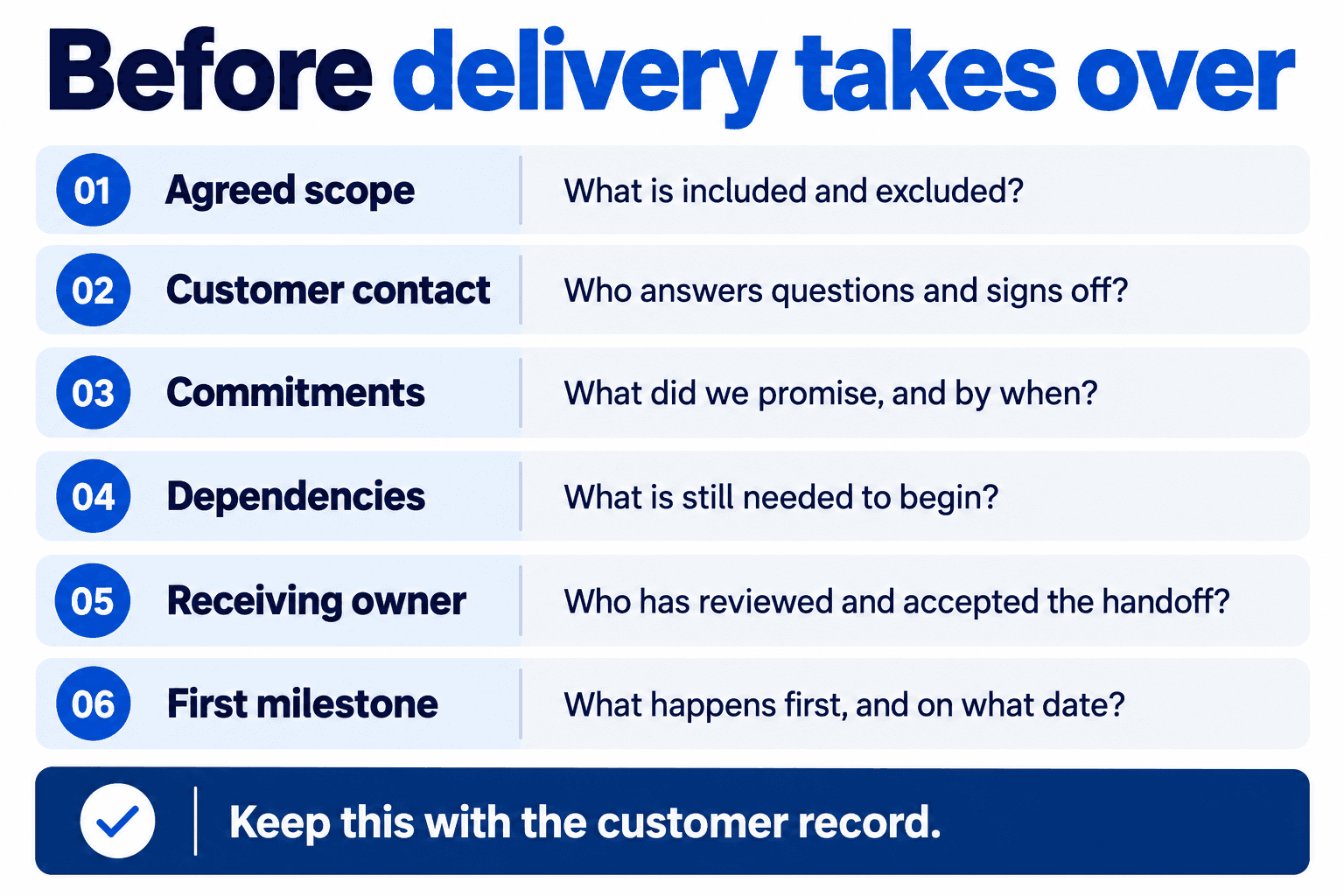
Consider a hypothetical reporting project. The customer has bought one management dashboard for a single business unit. Historical data cleanup is outside the agreed scope. The finance manager will answer questions, while the controller approves the output. A first review is planned for 5 November, subject to receiving the data export by 29 October.
The delivery lead accepts the handoff after checking the scope and flags the export as a dependency. Sales introduces that lead to the customer and explains who will coordinate the next steps. If the export is late, the team knows which milestone to revisit and who needs to discuss it.
This is an illustrative example, not a customer case study. Your checklist should reflect the commitments and approval roles in your own agreement.
Let the receiving owner accept the work
Assigning a name in the CRM does not tell you whether that person has reviewed the handoff. Give the receiving owner a clear way to accept it or return it with specific questions.
For a straightforward service, that review may be brief. A more involved project may need a short conversation between sales and delivery. Walk through the scope and the first milestone, then focus on anything that might change the plan. The aim is to surface missing information while the sales conversation is still fresh.
If the receiving owner cannot accept the work yet, record why and who will resolve the gap. Avoid moving the record forward just to make a report look complete. A visible unresolved question is easier to manage than a kickoff built on two different assumptions.
Once the handoff is accepted, introduce the delivery owner to the customer. Explain what that person handles, what happens next and where questions should go. Sales may stay involved in the relationship, but the customer should know who is coordinating delivery.
Keep delivery and billing connected to the deal
The handoff also needs to connect the sales record with the work that follows. Link the CRM opportunity to the project, service record or other place where delivery manages the work. Make the agreed scope and latest commitments easy to reach from both sides.
Where an ERP or connected billing system supports the process, confirm which agreed information moves across. The billing contact, purchase order reference and payment milestones should follow the contract and your internal controls. A deal marked won should not trigger an invoice unless the agreed billing conditions have been met.
Avoid creating several editable copies of the same scope. Agree where the current version lives and link to it. If the customer later asks for a change, record the request and follow the agreed review process before changing delivery dates or fees.
Software can help carry the information, but the team still needs to decide who maintains it. Test any connection using a sample deal and check what the delivery and finance teams actually receive.
Review the first few handoffs together
After introducing the checklist, look at a small set of new customers with sales and delivery. Ask what the receiving team had to chase, which commitments were unclear and whether the customer had to repeat information already provided.
Use the answers to improve the checklist. If access is regularly missing, add the relevant requirement earlier in the sales process. If dates are repeatedly tentative, agree how that uncertainty should appear in the record. If the delivery owner is assigned too late, change when that decision happens.
A useful handoff leaves the customer with confidence that the next person understands what was agreed. It also gives delivery enough context to start asking the right questions instead of repeating the first conversation.
If sales and delivery keep restarting the same conversation, eBusiness Solutions can help map a cleaner handoff and connect it to your CRM and ERP workflow.
Need a clearer CRM or ERP process?
Talk with eBusiness Solutions about connecting customer follow-up, sales, operations, and reporting around the way your team actually works.
Discuss Your CRM or ERP ProcessFrequently Asked Questions
Related Articles

Why Purchase Order Approvals Get Stuck and How to Fix Them
Find out where purchase requests get stuck and how clear approval rules, backup approvers and an ERP workflow can help your team move them forward.

Why Sales Leads Go Quiet and How to Build a CRM Follow Up Process
A practical CRM follow-up process gives every open lead a clear owner, next action, and date so promising enquiries do not disappear between inboxes and systems.