
Full Stack Development Services: Building Portals, Dashboards, Integrations, and Internal Tools
Learn how full stack development services help businesses build portals, dashboards, integrations, and internal tools that support operations and growth.
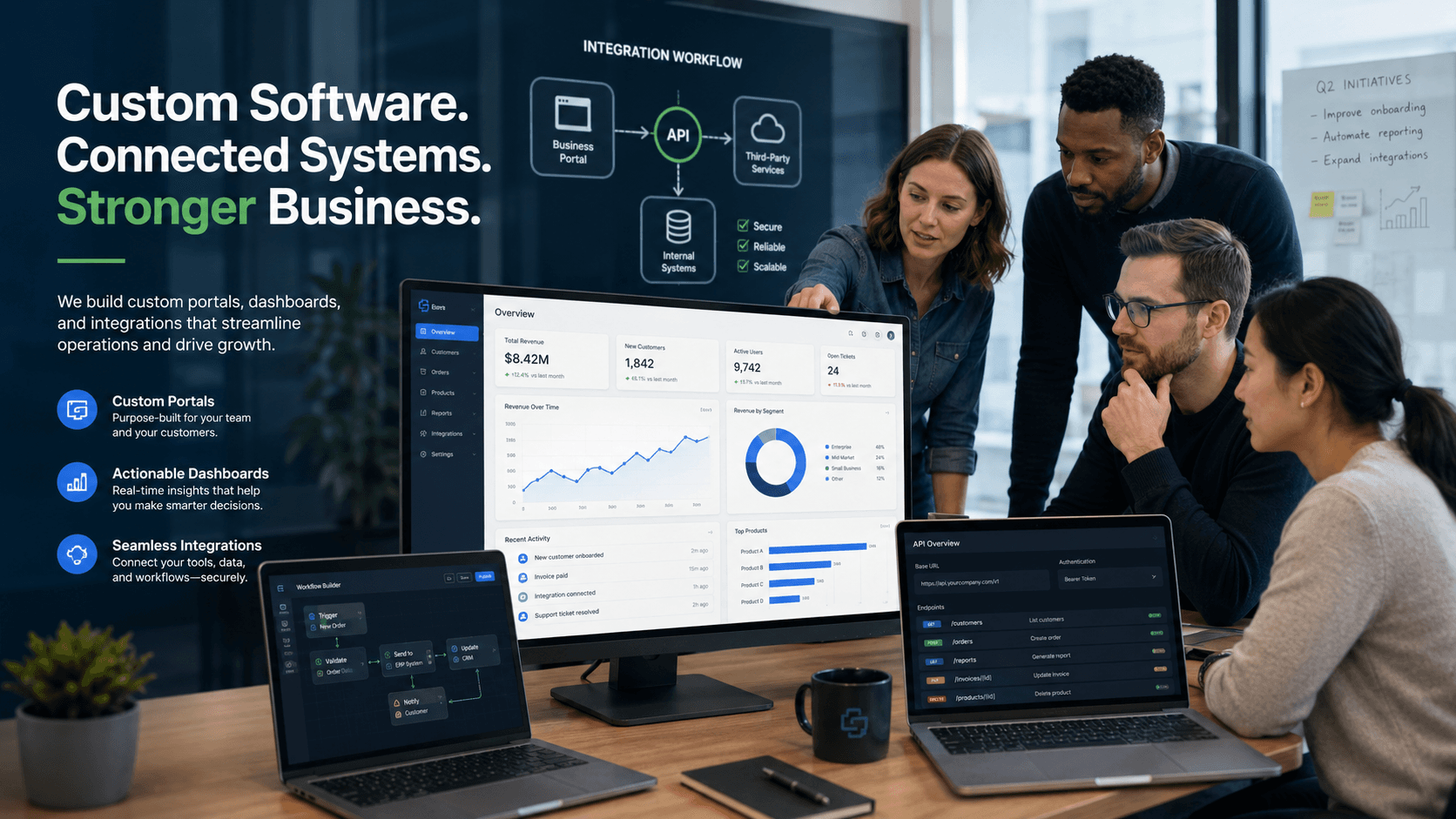
A website is often only the visible part of a company's digital operation. Behind it, teams may need customer portals, vendor portals, reporting dashboards, workflow tools, data integrations, approval systems, and internal applications that help the business run every day.
That is where full stack development services create value. A full stack team can work across the front end, back end, database, APIs, cloud environment, and integrations needed to build complete business applications. Instead of solving only the interface or only the server-side logic, full stack development connects the full experience from user action to business outcome.
For growing businesses, this matters because operational software often needs to do more than look good. It needs to move data accurately, support roles and permissions, automate repeatable work, integrate with ERP or third-party systems, and give leaders visibility into what is happening.
What Full Stack Development Services Include
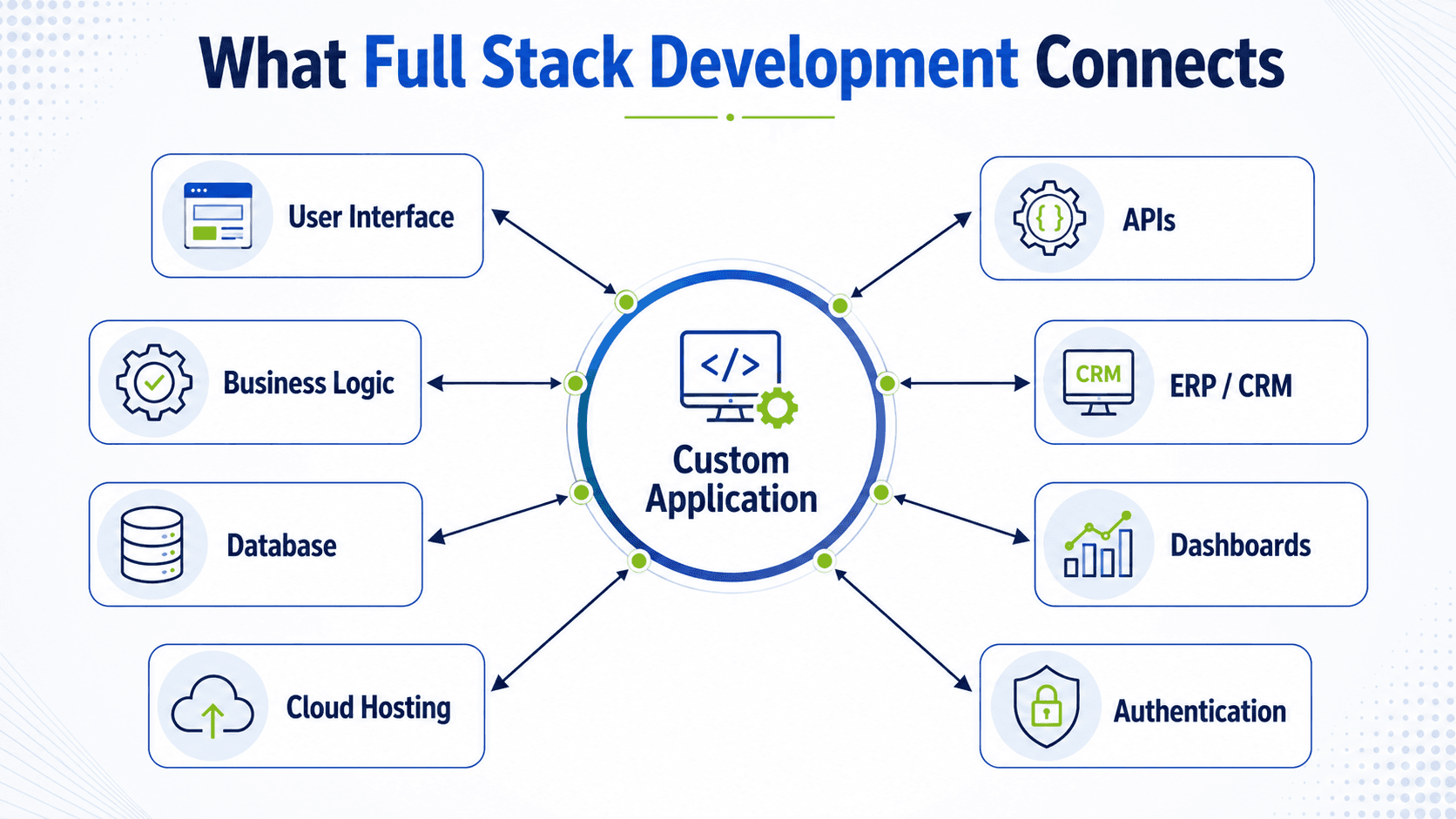
Full stack development services cover the planning, design, engineering, testing, deployment, and support required to build complete web applications and business software. A full stack team typically works across the user interface, application logic, database design, APIs, authentication, hosting, performance, and integrations.
This does not mean one person must do everything. In a mature delivery model, full stack development is a coordinated capability. Designers, front-end engineers, back-end engineers, database specialists, QA, DevOps, and project leads may all contribute. The important point is that the team can think across the whole system rather than treating each layer as a separate problem.
That end-to-end view is especially useful when a business application needs to connect with ERP, CRM, accounting, inventory, payment, reporting, or customer-facing systems.
Common Business Use Cases for Full Stack Development
Many companies first think about full stack development when they need a website or web application. In practice, the strongest business use cases often come from operational needs.
- Customer portals for account access, order status, service requests, document sharing, payments, or support workflows.
- Vendor or partner portals for onboarding, purchase orders, approvals, files, inventory updates, or collaboration.
- Executive dashboards that combine operational, sales, finance, inventory, or project data in one view.
- Internal tools that replace spreadsheets, email chains, and manual approval workflows.
- API integrations that connect ERP, CRM, eCommerce, accounting, payment, shipping, or reporting platforms.
- Workflow applications for requests, reviews, approvals, scheduling, inspections, tasks, or compliance tracking.
- Custom web applications that support a specific service model, customer experience, or operational process.
Why Businesses Need More Than a Website
A marketing website helps a company explain who it is and generate interest. But once customers, employees, vendors, or managers need to act on information, the business often needs an application, not just a page.
For example, a customer may need to log in and see order status. A warehouse manager may need to review exception reports. A finance team may need a dashboard that pulls from operational systems. A leadership team may need cleaner visibility across service delivery, project performance, or inventory movement.
In these scenarios, the user interface is only one part of the solution. The system also needs secure access, reliable data, business rules, notifications, integrations, audit trails, and ongoing support. Full stack development brings these pieces together.
How Full Stack Development Supports ERP and Odoo Projects
Full stack development is also valuable around ERP implementation. Odoo and other ERP platforms can manage many core workflows, but businesses may still need custom portals, dashboards, data connectors, mobile-friendly forms, reporting layers, or specialized internal tools around the ERP.
The right approach is not to build custom software for every request. It is to decide where the ERP should be the system of record, where standard platform capabilities are enough, and where custom development can improve the workflow without adding unnecessary complexity.
- A customer portal can expose selected ERP data without giving external users direct ERP access.
- A dashboard can bring ERP and non-ERP data together for leadership reporting.
- An internal workflow tool can simplify a process that is too specific for standard screens.
- An API integration can move data between Odoo, websites, payment tools, shipping providers, CRMs, or reporting platforms.
- A custom interface can make a complex workflow easier for occasional users or field teams.
What to Plan Before Building a Custom Application
Successful full stack development starts with business clarity. Before writing code, the team should understand the users, the workflow, the data, the system ownership model, and the operational outcome the application needs to support.
- Who will use the application, and what tasks do they need to complete?
- Which data should be created, viewed, edited, approved, or reported?
- Which system is the source of truth for each important record?
- What roles, permissions, and security controls are required?
- Which systems need to connect through APIs, exports, imports, or webhooks?
- What should happen when data is missing, duplicated, rejected, or changed?
- How will the application be tested, launched, monitored, maintained, and improved after release?
A Practical Full Stack Development Process
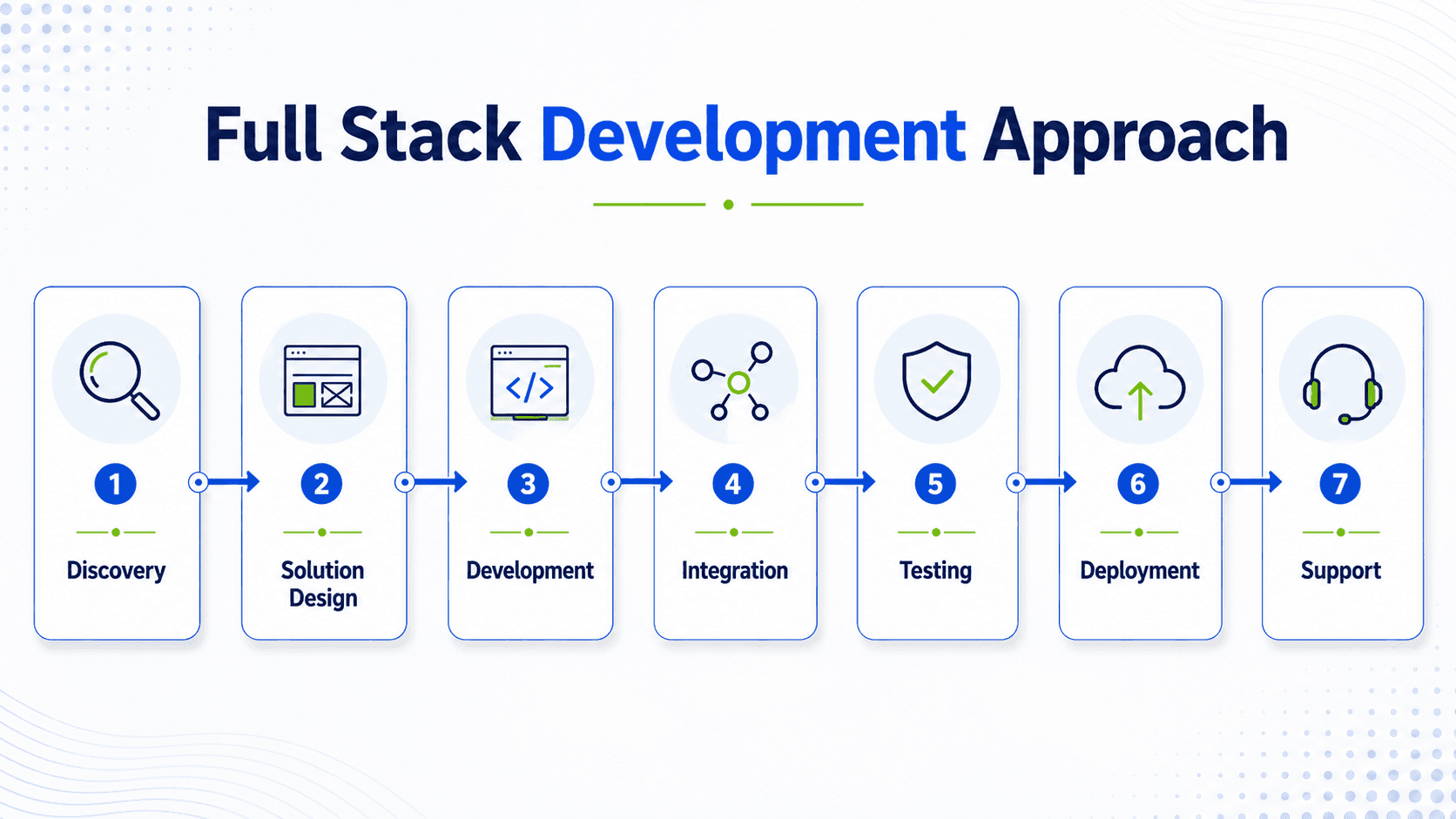
1. Discovery and workflow mapping
Document the current process, user roles, data sources, pain points, manual workarounds, and desired business outcome. This prevents the team from building a polished tool around an unclear workflow.
2. Solution design
Define the application structure, screens, data model, API needs, permissions, integrations, reporting requirements, and launch priorities. This is where the team separates must-have features from future enhancements.
3. Development and integration
Build the front end, back end, database, APIs, authentication, workflows, and integrations in controlled stages. Each stage should be testable and tied to a real user task.
4. Testing and deployment
Test core workflows, edge cases, permissions, performance, mobile responsiveness, browser behavior, failed integrations, and reporting accuracy before launch.
5. Support and iteration
Business software should improve after real usage. Monitoring, user feedback, bug fixes, documentation, and enhancement planning help keep the application useful as the business grows.
Common Mistakes to Avoid
- Starting with screens before the business workflow is clear.
- Building a custom tool when the ERP or CRM can already handle the process.
- Ignoring permissions, audit trails, and data ownership until late in the project.
- Connecting systems without defining what happens when synchronization fails.
- Treating launch as the end of the project instead of planning support and iteration.
- Overbuilding the first version instead of releasing a focused, usable application.
How eBusiness Solutions Helps
eBusiness Solutions supports full stack development for businesses that need practical digital tools beyond a standard website. The team can help plan, design, develop, integrate, test, and support portals, dashboards, workflow applications, internal tools, and custom web applications.
Because eBusiness Solutions also works across Odoo ERP implementation, customization, integration, migration, and IT staffing, the team can approach software development with a strong understanding of business process, system integration, technical delivery, and long-term support.
For companies in Ohio and across the United States, this combination can be useful when the goal is not just to launch software, but to improve how teams, systems, and customers work together.
Final Takeaway
Full stack development services help businesses build the digital tools that sit between people, processes, and systems. When planned well, a custom portal, dashboard, integration, or internal application can reduce manual work, improve visibility, and make day-to-day operations easier to manage.
The best projects begin with the business workflow, not the technology stack. Once the users, data, systems, and outcomes are clear, full stack development can turn that operating need into a practical application.
If your business needs a portal, dashboard, integration, internal tool, or custom web application, eBusiness Solutions can help you plan and build a solution that supports real operational work.
Need a custom portal, dashboard, or internal tool?
Talk with eBusiness Solutions about full stack development support for practical business applications, integrations, and workflow tools.
Discuss Full Stack DevelopmentFrequently Asked Questions
What are full stack development services?
Full stack development services help businesses build complete applications across the front end, back end, database, APIs, integrations, deployment environment, testing, and support.
When should a business choose custom software development?
Custom software development is worth considering when standard tools cannot support an important workflow, reporting need, customer experience, portal, integration, or internal process.
Can full stack development support ERP projects?
Yes. Full stack development can support ERP projects through custom portals, dashboards, API integrations, reporting layers, workflow tools, and user-friendly interfaces around the ERP.
What is the difference between a website and a web application?
A website mainly presents information and generates interest. A web application lets users log in, act on data, complete workflows, view records, submit requests, or interact with business systems.
How should a full stack project start?
It should start with discovery, workflow mapping, user requirements, data ownership decisions, security needs, integration planning, and a clear definition of the first usable release.