
Odoo ERP Case Study
From fragmented revenue systems to one unified Odoo platform
The client operated 6 brands across 3 to 4 business units and needed a single source of truth across marketing, CRM, quoting, contracts, subscriptions, invoicing, renewals, and support.
Client
Confidential SaaS holding company
Industry
SaaS, welding, engineering, and infrastructure
Service
Odoo ERP implementation and platform consolidation
Location
United States
The Challenge
Fragmented systems created handoffs, cost, and visibility gaps
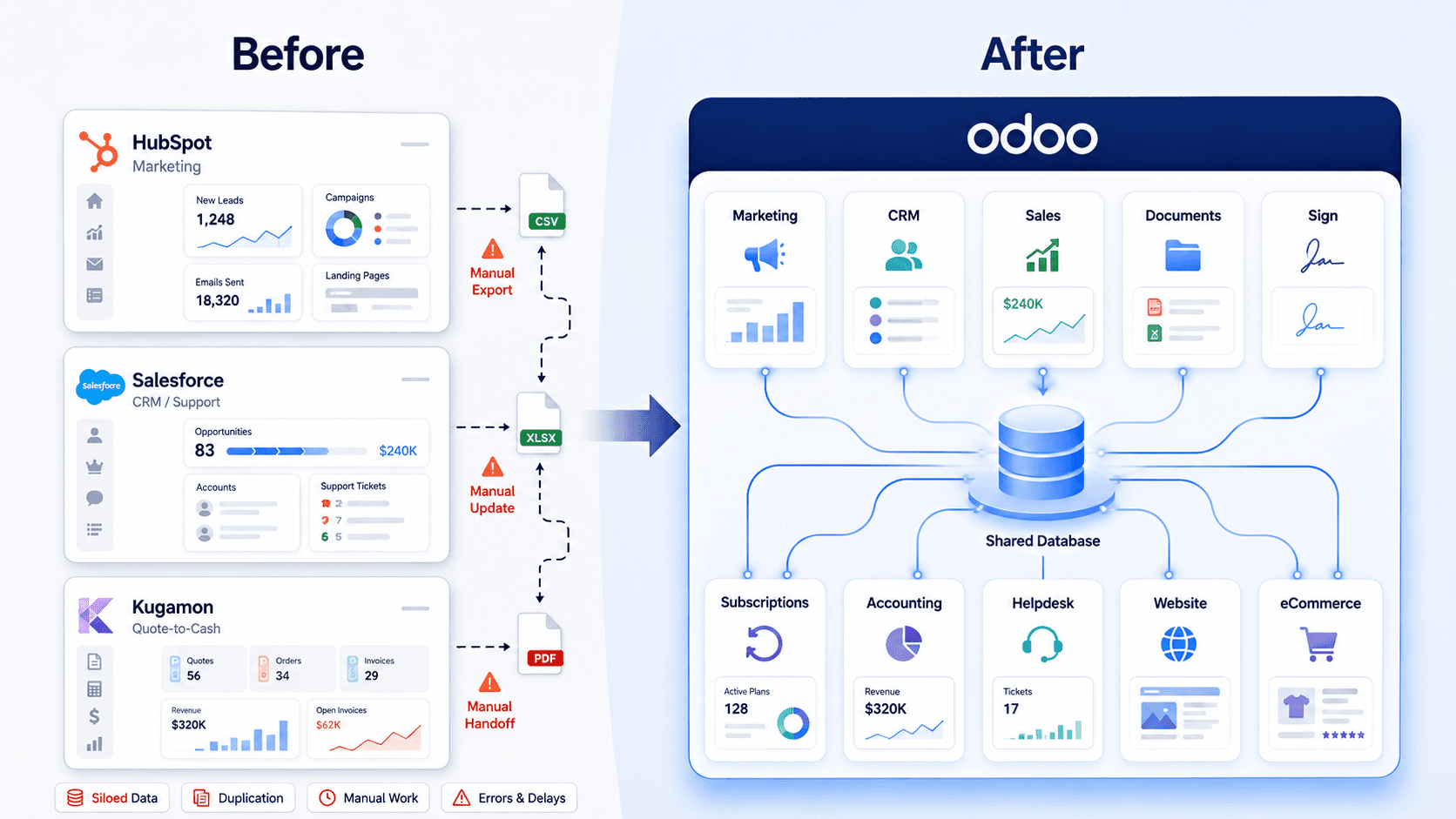
HubSpot, Salesforce, and Kugamon each handled a different part of the customer lifecycle. Because the systems were disconnected, teams dealt with manual reconciliation, duplicated effort, higher licensing costs, integration gaps, and limited executive visibility.
Marketing-to-sales handoffs were inconsistent because lead data did not flow cleanly from HubSpot into downstream sales workflows.
Salesforce managed CRM, quoting, and support data without native connection to subscription, contract, and invoicing records.
Kugamon added quote-to-cash functionality but increased licensing cost and bolt-on complexity.
Leadership lacked a single pane of glass across 6 brands and multiple business units.
3 to 1
Platforms consolidated
HubSpot, Salesforce, and Kugamon mapped into a single Odoo operating environment.
6
Brands supported
Multi-brand workflows planned around Odoo's multi-company and modular architecture.
100%
Source code access
Odoo can be customized at the code level for niche vertical workflows and reporting needs.
Module Mapping
Each legacy workflow was mapped to an Odoo module
The goal was to preserve critical capabilities while reducing manual handoffs, duplicate data entry, and inter-platform integration overhead.
| Legacy workflow | Odoo module | Impact |
|---|---|---|
| Salesforce CRM | Odoo CRM and Helpdesk | Opportunity tracking, pipeline visibility, and support case management move into a connected workflow. |
| Kugamon quotes and orders | Odoo Sales | Quote creation, approvals, product catalog, pricing rules, and sales orders can run in Odoo. |
| Kugamon contracts and eSign | Odoo Sign and Documents | Contract execution becomes part of the sales and subscription flow instead of a separate handoff. |
| Kugamon subscriptions | Odoo Subscriptions and Accounting | Renewals, recurring invoicing, and payment workflows are planned on the same customer record. |
| HubSpot marketing | Odoo Marketing, Website, eCommerce, and CRM | Campaigns, web leads, MQL to SQL tracking, and CRM follow-up operate in one environment. |
Implementation Methodology
Phased delivery from discovery to long-term support
The approach balances speed and risk: understand the current state, map features to Odoo, define an MVP, then expand after the foundation is live and stable.
- 1
Phase 1
Discovery and process mapping
Interview stakeholders, review current workflows, document tools moving data between modules, and identify bottlenecks across brands.
Deliverable: Scope document
- 2
Phase 1
Feature mapping and complexity matrix
Map each workflow to an Odoo module and rate effort as configuration, low-code, code changes, or addon development.
Deliverable: Feature and complexity matrix
- 3
Phase 1
MVP identification
Select the highest-value, lowest-risk starting point so the client can achieve early wins and control scope.
Deliverable: MVP scope, timeline, and pricing
- 4
Phases 2 and 3
Expansion beyond the MVP
Plan the next waves of functionality after Phase 1 is live and stable, including integrations and advanced optimizations.
Deliverable: Phase scopes, timelines, and pricing
- 5
Go-live
Training, support, and optimization
Provide user training, managed go-live, 30-day support, and a path for extended support and future Odoo upgrades.
Deliverable: Support and upgrade plan
Expected Outcomes
A clearer operating model for growth
The proposed Odoo end state connects the people, processes, and reporting needed to run the business with greater confidence.
A clear Odoo replacement strategy for the full revenue lifecycle.
Reduced integration overhead by planning around modules connected by design.
A practical data migration, QA, training, go-live, and support plan.
Executive-level visibility across brands, business units, and customer lifecycle stages.
Client Perspective
Confidence came from functional and technical depth
"eBusiness Solutions showcased deep functional and technical expertise to identify bottlenecks, map data migration paths, and define a clear go-live strategy."
Confidential client
SaaS holding company
"Their outcome-based methodology and ability to customize Odoo at the source code level means we get a system that fits our niche vertical workflows."
IT Manager
Operations leadership
"From day one, eBusiness suggested the right processes and methodology for each workflow, helping us see how to get the most done in the least time with Odoo."
CFO
Technology leadership
Case Study FAQ
Common questions about this Odoo operating model
Why was Odoo recommended for this SaaS holding company?
Odoo was recommended because the client needed one connected platform for marketing, CRM, quoting, contracts, subscriptions, invoicing, renewals, reporting, and support across multiple brands.
Which systems were mapped into Odoo?
The project mapped HubSpot, Salesforce, and Kugamon workflows into Odoo modules including CRM, Helpdesk, Sales, Documents, Sign, Subscriptions, Accounting, Marketing, Website, and eCommerce.
How does eBusiness Solutions reduce Odoo implementation risk?
eBusiness Solutions uses discovery workshops, feature mapping, a complexity matrix, MVP scoping, phased delivery, QA, role-based training, go-live support, and long-term optimization planning.
Ready to see what Odoo consolidation could look like for you?
We can review your current systems, map workflows to Odoo modules, and define a phased implementation plan for your business.